
Manufacturing and distribution
Decisions that keep orders moving
A rules engine for manufacturing that sits beside your ERP. Credit holds, PO approvals and supplier checks are answered in milliseconds, the same way on every shift, with a trace you can show anyone.
Incoming request
evaluatingCan order SO-18832 ship, or does it go on credit hold?
- If the order plus the outstanding balance goes over the credit limit, hold the order.
- If any invoice is more than 60 days overdue, hold the order.
- If the customer is on the key accounts list, route the hold to the credit manager rather than blocking it.
- Otherwise, release the order.
Answer, with the reason
Hold, routed to the credit manager. The order would take the balance to 27,600 GBP, which is 2,600 GBP over the limit. The customer is on the key accounts list, so the credit manager decides rather than the order being blocked outright.
Sound familiar?
Where orders stall on the way to the loading bay
Your plant and warehouse run on schedules. The decisions around them still run on inboxes, spreadsheets and whoever happens to be at their desk.
Credit holds nobody can explain
An order stops at the credit check. Sales asks why. Finance opens a spreadsheet, checks an ageing report and rings the customer. The truck leaves without it.
PO approvals that wait for the right person
Maintenance needs a part today. The PO sits with a manager who is on the shop floor, because nobody is sure whether it is over their limit or someone else's.
Rules locked inside the ERP customisation
The approval limits and hold rules were coded into the ERP years ago. Changing a threshold means a dev ticket, a test cycle and the next release window.
The quiet cost
What slow, inconsistent decisions quietly cost a manufacturer
- An order held for a customer who was fine, and a shipment that goes out a day late.
- An order released for a customer who was not, and a debt that is harder to collect.
- A new supplier used before the insurance certificate was checked.
- An auditor asking why a large PO was approved by someone below the limit, and nobody able to say.
Before and after
From chasing sign-off to orders that decide themselves
Today
- Credit hold rules live in one finance controller's spreadsheet.
- PO approval limits are coded into the ERP and change once a quarter.
- Supplier checks depend on who remembers to ask for the documents.
- When a customer disputes a hold, someone has to reconstruct what happened.
With Condexa
- Credit hold rules sit in one published decision your ERP calls on every order.
- Finance updates the approval limits table and publishes the change the same day.
- Every new supplier runs through the same readiness checks before they can trade.
- Every answer is recorded with its trace, so you can show exactly why it held.
How you get there
How manufacturers put their decisions into Condexa
- 1
Write the rule the way finance explains it
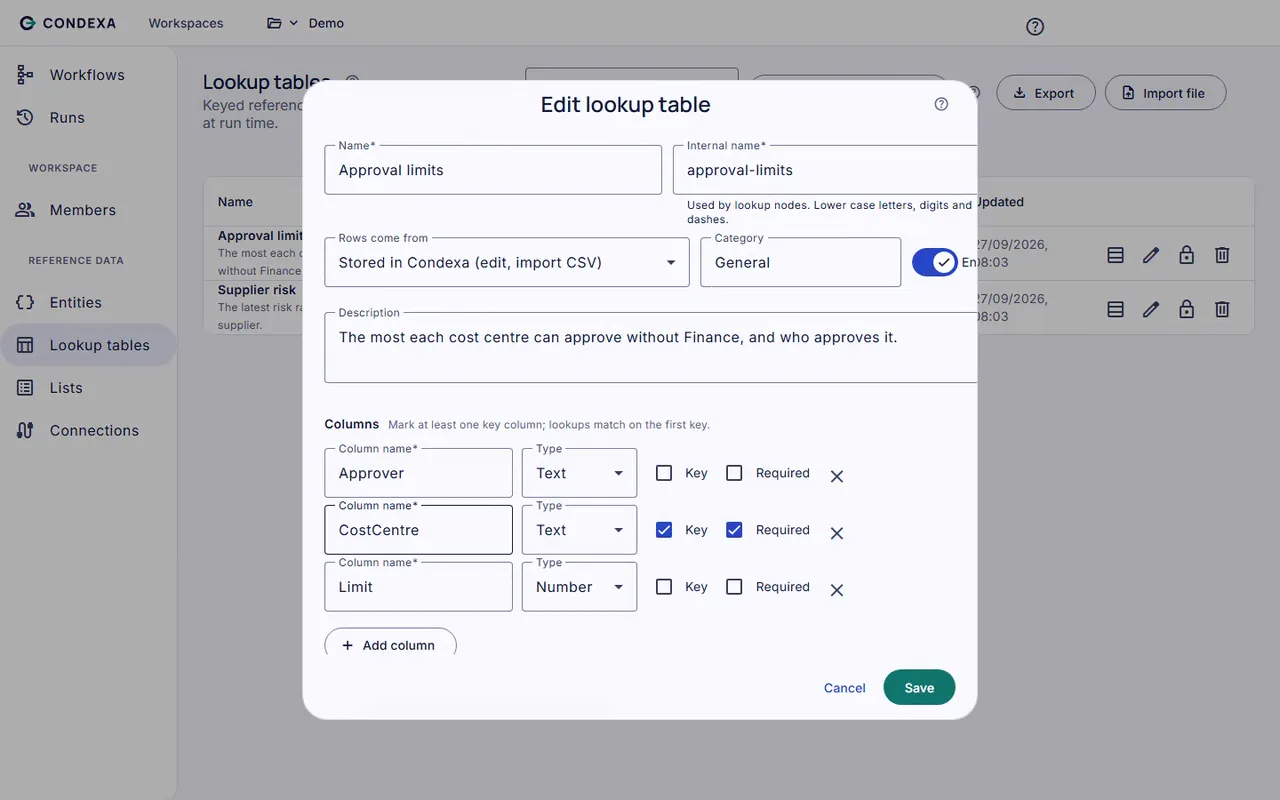
Build the credit or approval decision step by step on a visual canvas. Keep approval limits by cost centre and customer credit bands in lookup tables that finance owns.
- 2
Test it against real orders
Run the decision with last week's orders as examples. The trace shows every lookup, every value and which rule decided, so you can sign it off before it goes live.
- 3
Let the ERP ask
Publish the version and your ERP, CRM or Dynamics 365 calls it over a REST API. Order release, PO routing and supplier status all get their answer in milliseconds.
A worked example
Worked example: should this order go on credit hold?
A distributor places a repeat order worth 18,400 GBP. Their account has a 25,000 GBP credit limit and 9,200 GBP already outstanding.
The rules, in plain English
- R1If the order plus the outstanding balance goes over the credit limit, hold the order.
- R2If any invoice is more than 60 days overdue, hold the order.
- R3If the customer is on the key accounts list, route the hold to the credit manager rather than blocking it.
- R4Otherwise, release the order.
Condexa answers
Hold, routed to the credit manager. The order would take the balance to 27,600 GBP, which is 2,600 GBP over the limit. The customer is on the key accounts list, so the credit manager decides rather than the order being blocked outright.
FAQ
Questions people ask
What is a rules engine for manufacturing?
A rules engine for manufacturing holds the decisions that surround production and fulfilment, such as credit holds, PO approvals, supplier checks and pricing, outside your ERP code. Your ERP asks the rules engine for an answer and gets it back in milliseconds, and the people who own each policy can change it without a release.
Does Condexa replace our ERP?
No. Condexa sits beside your ERP and answers the decisions it needs to make. The ERP still runs orders, stock and invoicing. It simply calls Condexa over a REST API when it needs to know whether to hold an order, who must approve a PO, or whether a supplier is ready to trade.
How do we automate a purchase order approval matrix?
Put your approval limits in a lookup table, for example by cost centre and amount band. Build a decision that reads the PO, looks up the limit and returns who must approve. Your ERP calls it for every PO, and finance updates the table when limits change without asking IT.
Can the rules use data already in our systems?
Yes. A decision can read live data from SQL Server or Microsoft Dataverse through a lookup table or a database lookup step. You can point a connection at your test environment while you build and your live environment when you publish.
How long does it take to get a first decision live?
Most teams start with a guided pilot on one real decision, such as credit hold or PO approval, and have a working pilot in weeks. Changing a rule after that takes minutes.
Keep exploring
Related decisions and guides
Use cases
Credit decisions
Decide who gets credit, and how much, the same way every time, without waiting for the one person who knows the rules.
Read moreUse cases
Purchase order approval
Stop chasing sign-off by email. Encode your delegation of authority once and let the ERP know who must approve every PO.
Read moreUse cases
Supplier onboarding
Check every new supplier against the same criteria before the first order, not after something goes wrong.
Read moreFeatures
Lookup tables
Every limit change is a dev ticket? Put thresholds and bands in tables your business team edits and publishes.
Read moreIntegrations
SQL Server
Business rules buried in stored procedures? Keep your data in SQL Server and move the rules somewhere people can read.
Read moreStop orders waiting on a decision someone has to look up
Bring a decision your team makes every week. We will build it with you, live, test it against your own examples and show your systems calling it.
No slides. Your decision, built live. No obligation.